Epic Ze Zeus: Why Hacksaw Gaming Released One Slot with Three Different RTPs

Epic Ze Zeus arrived on 18 August 2026 with an unusual detail that matters more than its Greek-mythology theme or 50,000x maximum win: Hacksaw Gaming lists three separate RTP settings for the same title — 96.22%, 94.16% and 92.35%. The game itself is presented as one release, with 5/5 volatility, Cluster wins and the same core feature set built around Divine Squares, the Hand of Zeus, Coins, Zap of Zeus and the Vessel of Wealth. Yet the long-term mathematical return can differ significantly depending on which version a casino offers. Hacksaw Gaming has not published a statement saying that Epic Ze Zeus was given three RTP settings for one specific commercial reason, so it would be misleading to attribute a motive that the developer has never confirmed. What the release does show is a familiar approach in modern online slots: several approved mathematical configurations give operators more choice when adding a game, while players still need to check which version they are actually being offered.
What the Three Epic Ze Zeus RTP Versions Actually Mean
RTP, or Return to Player, describes the percentage of total stakes that a game is mathematically designed to pay back over a very large amount of play. In Epic Ze Zeus, the highest published configuration is 96.22%, followed by 94.16% and 92.35%. These percentages are not promises about an individual session. Playing £100 does not mean receiving exactly £96.22 back on the highest setting, because short-term results can be far above or below the mathematical average. The figure becomes meaningful only across a sufficiently large sample of bets. This distinction is particularly important in a slot with 5/5 volatility, where long periods without a substantial return can be interrupted by much larger wins. RTP therefore describes the underlying long-term balance of the game rather than predicting what will happen during the next ten, hundred or even thousand spins.
The difference between the three settings becomes clearer when each RTP is converted into its corresponding theoretical casino margin. A 96.22% RTP leaves a mathematical margin of 3.78%. At 94.16%, that rises to 5.84%, while the 92.35% version produces a 7.65% margin. Put another way, for every £100 of turnover across a very large statistical sample, the mathematical difference between the highest and lowest configurations is £3.87. That may appear modest when looking at a single £1 spin, but it becomes much more significant as total wagering accumulates. At £1,000 of theoretical turnover, the difference in expected return between 96.22% and 92.35% reaches £38.70. Again, this is a mathematical expectation rather than a prediction of an actual balance, but it shows why identifying the correct RTP version is not a minor technical detail.
Hacksaw Gaming lists all three percentages on the official Epic Ze Zeus game page alongside one overall set of game data: 5/5 volatility, Cluster wins and a maximum win of 50,000 times the stake. The game is therefore not marketed as three separate titles called, for example, Epic Ze Zeus High RTP, Medium RTP and Low RTP. Players see Epic Ze Zeus, while the operator selects an available configuration for its own game catalogue. This is what can make multi-RTP slots confusing. A review may quote 96.22% because that is the highest published value, while a casino may actually be running the 94.16% or 92.35% version. The game name alone is therefore not enough to establish the return percentage that applies at a particular casino.
The Same Core Game Can Carry a Different Long-Term Return
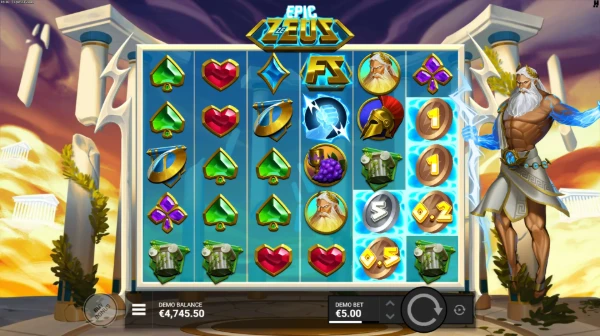
The three RTP values do not turn Epic Ze Zeus into three visibly different slot concepts. Its central structure remains based on Cluster wins and the Divine Squares mechanic. After a winning combination, positions behind the winning symbols become Divine Squares. When a Hand of Zeus appears, those highlighted positions are activated and can reveal Bronze, Silver or Gold Coins. Coin values are linked to the player’s stake, while other special symbols can alter the amounts that have appeared. This system gives the slot much of its identity, and it remains the recognisable feature structure attached to Epic Ze Zeus regardless of the RTP percentage shown for the particular version being offered.
Zap of Zeus and Vessel of Wealth symbols add another layer to the mechanic. According to Hacksaw Gaming’s official game information, an activated Zap of Zeus can apply a multiplier of up to 10x to Coins and existing Vessel of Wealth symbols on adjacent squares. A Vessel of Wealth, when activated, collects the values of Coins and other Vessels visible on the grid and stores their combined amount. These features matter when assessing the three RTP versions because a lower RTP does not necessarily mean that a casino has removed the most recognisable bonus mechanic or replaced the artwork. The mathematical difference can sit behind a game that looks and behaves in a broadly familiar way from the player’s perspective. Different probabilities or other elements of the approved mathematical model can alter long-term return without requiring the game to be presented under a different name.
That is also why checking a generic slot review is not sufficient when real money is involved. A page written around the 96.22% version may describe the title correctly while still giving the wrong RTP for a specific casino installation. The more reliable place to check is the information, rules or paytable section inside the actual game being offered. In regulated markets, player-facing information about theoretical return is an important part of informing customers about their chances. A listed RTP should therefore be treated as a property of the exact version being played, rather than a permanent number attached to the Epic Ze Zeus name everywhere. If two casinos show different RTP percentages for Epic Ze Zeus, that does not automatically mean one of them has published an error; they may simply be using two different configurations supplied for the same title.
Why Hacksaw Gaming Offers More Than One RTP Setting
Hacksaw Gaming’s public Epic Ze Zeus page confirms that three RTP settings exist, but it does not give a direct explanation of the commercial decision behind them. The practical purpose of multiple RTP configurations is nevertheless straightforward: they allow the same game to fit different operator requirements without requiring the developer to create a completely separate slot for each case. Casinos operate with different commercial models, game portfolios, promotional structures and market conditions. Giving them several pre-defined return settings provides flexibility when choosing which version to add. The key distinction is that the operator is choosing from configurations created for the game; it is not inventing an arbitrary percentage for Epic Ze Zeus. The published range is defined by the supplier, and the available implementation still has to meet the technical and regulatory requirements that apply in the relevant jurisdiction.
The financial effect is easy to see from the three percentages. A casino using the 96.22% version accepts a smaller theoretical margin on the slot than one using the 92.35% version. From the operator’s perspective, that difference can influence revenue across large volumes of wagering. From the player’s perspective, the opposite applies: the highest RTP represents the smallest mathematical disadvantage of the three published options. This creates a clear commercial reason for multi-RTP games to exist as a category. A casino can decide how a title fits within its overall economics, while the developer can distribute essentially the same recognisable game to businesses with different requirements. None of this changes the basic meaning of the RTP itself. A lower percentage does not make every session a losing one, just as the 96.22% setting does not make a profitable session likely or guaranteed.
Different markets can also impose different rules on game design, disclosure, stakes and product features. That does not mean Epic Ze Zeus has three RTPs because three particular regulators demanded three particular numbers; there is no public evidence from Hacksaw Gaming supporting such a claim. Rather, offering several mathematical builds can make distribution more flexible across a large international business. Each operator still needs to use a version permitted under the rules that apply to it. In Great Britain, for example, remote games are subject to technical standards and independent testing requirements, while relevant information about the game’s chances, including RTP where applicable, must be available to customers before they commit to gamble. Multi-RTP distribution therefore should not be confused with an operator secretly changing the return whenever it wants. The deployed game has a defined mathematical design that is expected to perform according to the version being offered.
The Casino Chooses the Available Version, Not the Individual Player
One of the most important misconceptions about variable RTP is the idea that a casino can simply reduce a slot’s payout percentage after a player starts winning. That is not what the three Epic Ze Zeus figures represent. They are separate published configurations of the title rather than a slider that changes the odds in response to an individual’s account balance or recent results. Once an approved version is deployed, its mathematical behaviour is supposed to correspond to that version. In regulated environments, game software and the stated theoretical RTP are subject to testing, and operators are expected to monitor live performance to ensure games continue operating according to their design. A 92.35% version may be less favourable mathematically than a 96.22% version, but that difference should exist because a different game configuration was selected, not because the software decided that one particular player should receive worse results.
This also explains why two people can report different RTP figures while both are looking at authentic Epic Ze Zeus games. One casino may have selected 96.22%; another may have chosen 94.16%; a third may use 92.35%. The logo, Zeus character, grid and bonus names can still appear familiar in each case. For a player, the sensible comparison is therefore not simply “Does this casino have Epic Ze Zeus?” but “Which Epic Ze Zeus RTP does this casino offer?” That extra check is especially relevant when the gap is 3.87 percentage points from the highest to the lowest published version. The difference will not determine what happens in a short session, but over the mathematical life of the game it is substantial enough to affect expected value.
A casino also cannot legitimately solve this difference by advertising the highest figure while quietly running another configuration if that presentation conflicts with the disclosure rules applying in its market. The relevant RTP is the one attached to the actual game version available to the customer. This is why screenshots, old reviews and general game databases should be treated as secondary evidence. Epic Ze Zeus was released only in August 2026, and information can quickly become inconsistent when websites copy a single headline percentage without checking individual installations. The most useful habit is simple: open the game’s information panel before spending money and confirm the percentage displayed there. That takes less time than comparing long reviews and provides a figure tied directly to the version currently loaded by the casino.
How the RTP Difference Changes the Assessment of Epic Ze Zeus
RTP should not be considered in isolation from Epic Ze Zeus’s volatility. Hacksaw Gaming gives the slot its maximum 5/5 volatility rating, meaning results can vary sharply over short and medium periods of play. A player may encounter extended sequences with limited returns and then see a feature produce a much larger payout. This variance can make the difference between 96.22% and 92.35% difficult to recognise from personal experience. Someone playing the lower-RTP version can have an excellent session, while another person on the highest setting can lose quickly. That does not contradict the mathematics. Volatility describes how unevenly results can be distributed; RTP describes the long-term proportion of stakes designed to return as winnings. The two measurements answer different questions and should not be used interchangeably.
The 50,000x maximum win needs similar context. It is a ceiling, not an indication that a large payout is common. The official specification presents that maximum alongside 5/5 volatility, which already signals that Epic Ze Zeus is designed around substantial swings rather than steady, predictable returns. Its three free-spin features can strengthen the game’s high-variance character. Three FS symbols trigger eight free spins in What If Zeus Was One of Us?, where Divine Squares remain highlighted until activation. Four FS symbols trigger 12 free spins in Ze Zeus Take the Wheel, where Divine Squares remain highlighted even after activation. Five FS symbols lead to 12 free spins in Ze Zeus Might Be Superstar, with a Hand of Zeus guaranteed on every free spin and Coins restricted to Silver or Gold. These features can produce concentrated payouts, but none removes the underlying RTP difference between available versions.
The highest published RTP is therefore the more favourable of the three choices from a purely mathematical perspective, but it does not turn Epic Ze Zeus into a low-risk game. Its 5/5 volatility remains a major factor in bankroll behaviour and short-session outcomes. Likewise, playing the 92.35% configuration does not mean losing 7.65% of every wager. Individual outcomes are random, and the theoretical margin emerges only across a very large volume of bets. A player deciding between identical-looking versions should still prefer the higher RTP when all other conditions are equal, because there is no mathematical advantage in accepting a lower long-term return. That comparison is different from claiming that the higher setting provides a reliable way to win. It simply reduces the built-in mathematical margin relative to the other two published versions.
What Players Should Check Before Spending Money
The first check should be the RTP shown inside the live game information rather than the percentage quoted in search results or on an older review page. For Epic Ze Zeus, the official supplier confirms that 96.22%, 94.16% and 92.35% all exist, so a single external figure cannot safely represent every casino offering the title. If the in-game rules state 96.22%, that is the version relevant to the session. If they state 94.16% or 92.35%, the mathematical return is lower even though the slot may otherwise look familiar. If the percentage cannot be found easily, players should be cautious about relying on an unaffiliated website to fill the gap. The purpose of checking is not to predict the next result, but to understand the conditions attached to the exact game before money is committed.
The second check is volatility and personal spending limits. Epic Ze Zeus carries the highest volatility rating in Hacksaw Gaming’s five-point system, so the bankroll required to tolerate normal swings can be very different from that of a lower-volatility slot. A high RTP does not cancel this characteristic. A player can still experience a rapid sequence of losing spins at 96.22%, just as a large win can occur on the 92.35% version. Setting a fixed spending limit before play is more useful than increasing stakes after losses in an attempt to force the mathematics to “catch up”. RTP has no memory and does not create a debt that the game must repay during the current session. Previous losing spins do not make a large win due, and previous wins do not mean the next spin has been deliberately weakened.
Epic Ze Zeus is therefore a useful 2026 example of why the RTP attached to a slot name should no longer be assumed to be universal. Hacksaw Gaming publicly lists three return settings — 96.22%, 94.16% and 92.35% — while keeping them under one title with the same published 5/5 volatility rating and 50,000x maximum win. The difference exists primarily in the long-term mathematics, and the spread from the highest to lowest version is large enough to matter when comparing casinos. The supplier has not publicly stated a single official reason for creating exactly these three percentages, but the structure gives operators a choice of predefined return models and gives players a reason to verify the game information themselves. For anyone considering Epic Ze Zeus, the most relevant RTP is not the number repeated most often online; it is the percentage displayed for the exact version available where the game is being played.