Temple Tumble Megaways by Relax Gaming — Tumble Mechanics and the Multiplier Ladder in Long Sequences

Temple Tumble Megaways, released by Relax Gaming, remains one of the most technically refined Megaways slots available in 2026. Built around cascading reels and an expanding multiplier ladder, the game focuses less on short bursts and more on sustained sequences that can dramatically alter payout dynamics. Its mathematical model is designed to reward consecutive wins within a single spin, particularly during bonus rounds, where multipliers escalate without resetting until the sequence ends.
How the Tumble Mechanic Shapes Volatility and Session Flow
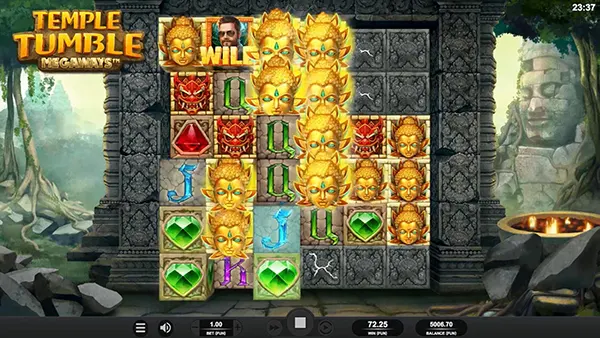
The tumble mechanic in Temple Tumble Megaways works through cascading reels: whenever a winning combination lands, the contributing symbols disappear, allowing new ones to fall into place. This continues until no further wins are formed. Importantly, all cascades occur within a single paid spin, meaning players are not charged for additional drops. This structure directly influences both perceived and actual volatility.
Unlike traditional slots with fixed paylines, the Megaways system dynamically alters the number of ways to win on every spin, reaching up to 117,649 possible combinations. When combined with cascades, this creates a layered outcome model where one spin can produce several sequential payouts. However, because symbol distribution is randomised per reel height, extended sequences are statistically infrequent, reinforcing the slot’s high volatility profile.
From a gameplay perspective, this mechanic extends the emotional and mathematical lifespan of a spin. Instead of evaluating outcomes instantly, players observe evolving reel states. In long sequences, this delay increases engagement but also amplifies bankroll swings, particularly when combined with multiplier progression.
Symbol Structure, Hit Frequency and Reel Dynamics
The slot uses six reels with up to seven symbols per reel, with varying heights generated by the Megaways engine. Lower-value symbols are represented by card ranks, while premium symbols include themed temple icons. A wild symbol substitutes for all standard symbols, increasing combination potential during cascades.
Base game hit frequency is moderate compared to many high-volatility Megaways titles, but most base wins are modest in size. The true structural value lies in chaining multiple tumbles. Because each cascade recalculates winning combinations across potentially expanded reel heights, symbol density becomes crucial in sustaining sequences.
Scatter symbols trigger the free spins feature when three or more appear. Notably, scatter wins are paid regardless of position and do not require adjacency, aligning with the broader Megaways format. Their appearance frequency is balanced to maintain bonus rarity, which is where the multiplier ladder becomes central.
The Multiplier Ladder — Core Engine of Extended Bonus Potential
The defining feature of Temple Tumble Megaways is its Multiplier Ladder, active during free spins. Each winning cascade increases the multiplier level by one step, climbing progressively throughout the bonus round. Crucially, the multiplier does not reset after individual tumbles; it only resets once the entire free spins session concludes.
The ladder starts at 1x and can climb significantly during sustained sequences. In practical terms, if a player achieves several consecutive cascades across multiple spins within the bonus, the accumulated multiplier can amplify even mid-sized symbol combinations into substantial payouts. This creates a compounding effect rarely seen in standard Megaways structures.
Because the multiplier persists across spins, the feature encourages longer streaks rather than isolated wins. Mathematically, this increases payout variance: most bonus rounds end at relatively low multipliers, but occasional extended streaks drive the majority of the game’s RTP contribution.
Why Long Sequences Matter More Than Single High Symbols
In many high-volatility slots, premium symbols alone determine large wins. In Temple Tumble Megaways, however, multiplier progression often outweighs symbol tier. A chain of five or six consecutive cascades at an elevated ladder level can surpass the payout of a single high-symbol hit at base multiplier.
This shifts strategic understanding. While players cannot influence outcomes, recognising the structural importance of cascade length helps frame realistic expectations. The game’s design prioritises momentum: once a ladder climbs, each additional tumble becomes exponentially more valuable.
Data from long-term gameplay tracking communities shows that extended ladder climbs are relatively rare but disproportionately impactful. A significant portion of high-end wins reported between 2023 and 2025 originated from bonus rounds where multipliers exceeded mid-tier levels rather than from isolated maximum Megaways spins.
Mathematical Profile, RTP and 2026 Relevance
As of 2026, Temple Tumble Megaways typically operates at a theoretical RTP of 96.10%, though operator settings may vary slightly depending on jurisdiction. Its volatility is categorised as high. This means extended losing streaks are statistically possible, balanced by occasional high-multiple outcomes driven by the bonus ladder.
The slot also includes a bonus buy feature in markets where permitted. This allows direct access to free spins at a cost significantly higher than the base bet. While this reduces variance in terms of bonus access frequency, it does not alter underlying probability. The multiplier ladder mechanics remain unchanged.
From a regulatory and player-protection standpoint, most UK-licensed operators clearly display RTP configurations and volatility information. Since UK bonus buy restrictions have evolved over recent years, availability depends on the specific licensing framework under which the game is offered.
Bankroll Management and Practical Considerations
Given the high-volatility structure and reliance on sustained sequences, session planning becomes critical. Smaller bankrolls may struggle to endure base game variance while waiting for a productive bonus round. Adjusting stake size relative to total session funds is essential for controlled play.
Players should also be aware that multiplier-driven slots can create misleading momentum perception. Several minor cascades do not guarantee a significant outcome unless the ladder escalates meaningfully. Understanding that most bonus rounds will conclude at low multipliers prevents unrealistic expectations.
In 2026, Temple Tumble Megaways remains relevant precisely because of this balance between structural complexity and transparency. Its tumble mechanic and persistent multiplier ladder offer a clear mathematical identity: rare but powerful extended sequences define its payout landscape, rather than constant small wins.